Lightning Protection System Installation and Construction Supervision
Accountability from Design Through Completion
A well-engineered lightning protection system design is only half the equation. The other half is execution, and that’s where most systems quietly fall short. Wire tensioned incorrectly, a ground rod set a few feet from spec, a connection left loose behind a wall: none of it shows up until the day a strike tests it. LEC closes that gap by supervising installation as rigorously as we engineer the design behind it.
Lightning protection is not a “plug-and-play” solution. Site conditions, grounding characteristics, structure geometry, and operational requirements all influence how well a system ultimately performs. That's why LEC offers turnkey installation services under our own direct supervision — built around whatever delivery model fits your project and workforce.
Delivery Models
- Turnkey. Complete turnkey installations performed by LEC personnel.
- Supervised. Supervised installations using qualified local or specialty contractors.
- Hybrid. Hybrid models combining local execution with LEC oversight.
What LEC Supervision Ensures
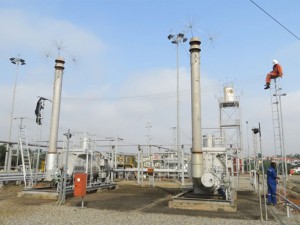
Correct equipment installation, including proper placement and configuration of our proprietary Dissipation Array® System (DAS®) units, which prevent lightning from occurring in a protected area
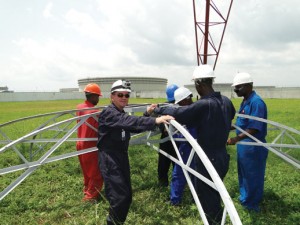
- On-site contractor training. Contractors trained on-site by LEC.
- Real-time quality verification. Assembly verified during construction, not after the fact.
- Early deviation correction. Deviations addressed before they become permanent problems.
- Grounding integrity. Proper grounding design and installation.
- Engineering standards. Adherence to LEC engineering standards and best practices.
- Design-intent verification. Confirmation that the completed system matches the approved design intent.
- Quality workmanship. Professional workmanship and quality installation practices throughout.
This end-to-end accountability minimizes risk for customers and eliminates uncertainty around installation quality — one of the most common failure points in lightning protection systems.
Installation Considerations for the Dissipation Array® System (DAS®)
For every DAS® installation, LEC supervision is essential. Proper wire tensioning, orientation, grounding integrity, and assembly technique are the difference between a system that performs as designed and one that merely “looks installed.”
LEC's No-Strike Warranty applies only to DAS® systems installed under LEC supervision. This requirement allows LEC to:
- Validate that the system was installed correctly.
- Ensure proper operation at the time of commissioning.
- Confirm grounding integrity and electrical continuity.
- Issue a Certificate of Completion once the system is placed into service.
Certificate of Completion
The Certificate of Completion provides documented assurance that a DAS® installation meets LEC's specifications and qualifies for warranty coverage — an important consideration for insurers, regulators, and risk managers.