- We Prevent Lightning Related Problems.


Are Internal Floating Roof Tanks (IFRTs) Safe From Lightning?
March 17, 2026
Protecting Tissue Mills from the Impacts of Lightning
April 1, 2026Lightning Protection for Geodesic Dome Storage Tanks | A Success Story
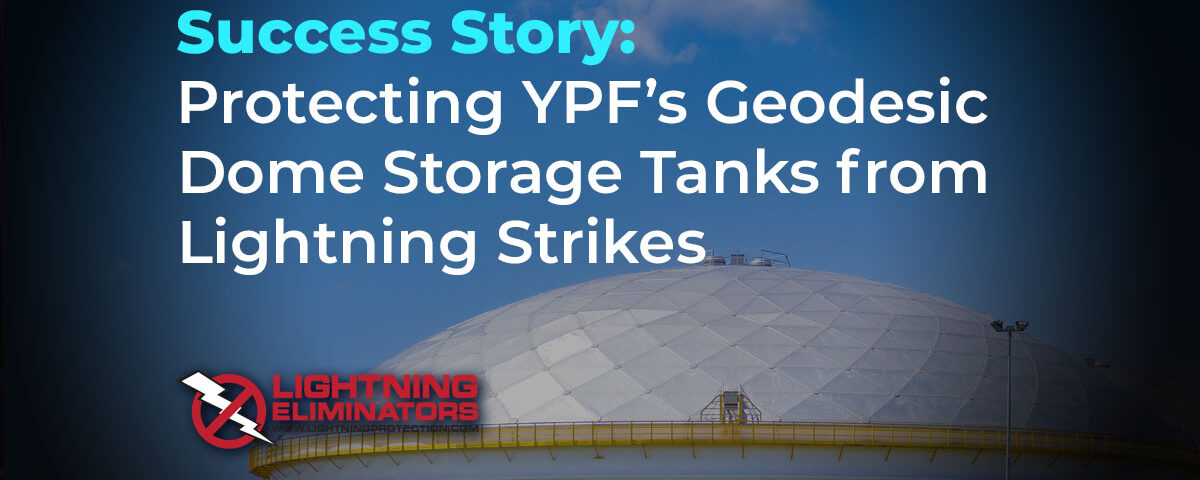
For tank farms storing crude oil, condensate, and other flammable liquids, lightning isn’t just a weather event – it’s a serious operational and safety risk. For YPF, S.A., Argentina’s national oil company, ensuring the integrity of new crude oil storage tanks meant addressing that risk head-on.
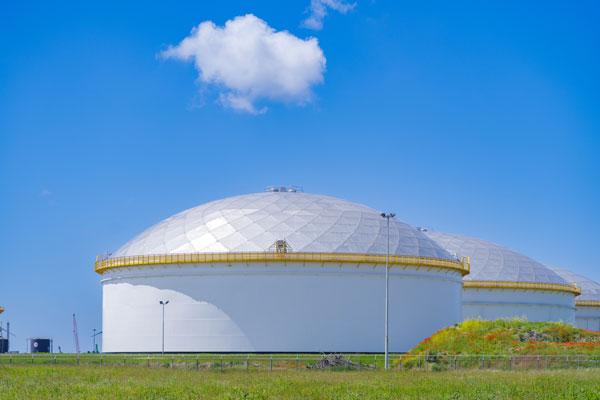
As part of a major EPC project, YPF incorporated lightning protection into the design of two large geodesic dome crude oil storage tanks, an uncommon and technically demanding application.
The Challenge: Lightning Protection for Geodesic Dome Tanks
Geodesic dome tanks offer clear advantages: lightweight aluminum construction, corrosion resistance, faster installation timelines, and reduced maintenance compared to traditional steel roofs. But those same characteristics introduce unique lightning vulnerabilities.
Unlike steel-roof tanks, aluminum domes:
- Are more susceptible to lightning attachment due to their geometry and material properties
- Require careful grounding and current dissipation strategies
- Protect internal floating roofs, but still need external strike prevention
For YPF, the stakes included:
- Preventing ignition risks in crude oil storage
- Avoiding damage to tank structures and seals
- Maintaining safe, continuous operations
- Integrating protection into a complex, fast-moving construction schedule
This wasn’t a standard tank protection scenario, and it required a tailored approach.
The Solution: A Customized Lightning Prevention Approach for Geodesic Dome Storage Tanks
YPF chose Lightning Eliminators & Consultants (LEC) to engineer a site-specific solution built around our patented Dissipation Array® System (DAS®) engineered to prevent lightning strikes instead of just managing their effects.
One of the significant vulnerabilities of traditional lightning protection systems is that they work by attracting lightning into the area intended to be protected, then intercept and safely conduct lightning energy to the ground. In contrast, DAS units take a fundamentally different approach by reducing the electric field conditions that allow lightning to form in the first place.
For this application, each DAS unit was customized specifically for the geometry and configuration of the geodesic domes.
Key elements included:
- Four layers of dissipation arrays mounted across each dome
- 144 dissipation arms per tank, creating a dense protective field
- 55 conductors per tank, connecting the system directly to the steel tank shell for grounding
- Thousands of feet of conductor wire, forming the functional charge dissipation network
Unlike conventional lightning protection, the DAS system:
- Requires no external power source
- Uses the natural electrical potential of approaching storms
- Dissipates charge through ionization, reducing the likelihood of a lightning strike forming in the first place
The result is a proactive, rather than reactive, approach to lightning protection.
The Installation: Precision, Coordination, and Quality Assurance
This project also introduced a unique installation method.
Instead of assembling the dome in place, the structure was:
- Fully assembled at ground level
- Outfitted with brackets and mounting hardware by the local construction team
- Then lifted into position on top of the tank
LEC’s specialists then:
- Installed the dissipation wiring system
- Completed final connections and grounding
- Conducted detailed inspection and validation
- Provided a Certificate of Completion to document the installation meet’s LEC’s specifications and qualifies for warranty coverage
This hybrid approach, combining local labor with specialized oversight, ensured both efficiency and technical precision.
It also enabled the system to meet the requirements for LEC’s no-strike warranty, a critical assurance for high-risk facilities.
The Insight: Lightning Protection Must Be Engineered, Not Assumed
A common misconception is that geodesic dome tanks are inherently protected from lightning due to their aluminum construction.
In reality:
- While domes help distribute electrical energy, they do not eliminate strike risk
- Without a dedicated dissipation system, lightning attachment and damage remain real threats
YPF’s decision to proactively integrate a DAS solution reflects a deeper understanding: Modern tank design and effective lightning protection must work together, not independently.
The Result: Enhanced Lightning Protection for Critical Energy Infrastructure
With the DAS system fully integrated, YPF’s geodesic dome tanks now benefit from:
- Reduced likelihood of direct lightning strikes
- Improved grounding and current dissipation
- Lower risk of damage, downtime, and safety incidents
- A protection system engineered specifically for their application
This project highlights an important takeaway for operators of tank farms, oil terminals, refineries, gas processing plants, and other oil and gas production facilities:
Innovative infrastructure requires equally advanced protection strategies.
Don’t Leave Lightning Protection to Chance
If your facility includes storage tanks, terminals, or other critical infrastructure, lightning risk should be addressed as part of the design, not after the fact.
A tailored, engineered approach can mean the difference between uninterrupted operations and costly disruption.
Contact us today to schedule a risk assessment and discover how proactive lightning prevention can safeguard your operations and Keep You Running Through the Storm.