- We Prevent Lightning Related Problems.


Join Lightning Eliminators at the 2025 CRSC Safety & Health Conference & Expo
September 19, 2025
World’s Best Lightning Protection Products
September 29, 2025API 545 | Why Bypass Conductors for Floating Roof Tanks Still Matter
at
Every year, lightning causes billions of dollars in damages to energy infrastructure. In the petroleum sector alone, industry data shows 15 -20 floating roof tank fires annually are triggered by lightning. These aren’t minor events either - incidents like the 2011 Cilacap refinery fire in Indonesia caused more than $292 million in damages, halted production for months, and displaced hundreds of workers.
For operators of external floating roof tanks (EFRTs), lightning protection isn’t just about checking a box , it’s an ongoing, high-stakes challenge. And while API 545 was formally withdrawn by the API, its most critical recommendation, installing bypass conductors, remains as relevant as ever.
For operators of external floating roof tanks (EFRTs), lightning protection isn’t just about checking a box , it’s an ongoing, high-stakes challenge. And while API 545 was formally withdrawn by the API, its most critical recommendation, installing bypass conductors, remains as relevant as ever.
Understanding API 545: A Standard with Lasting Impact
The American Petroleum Institute (API) introduced API RP 545 in 2009 with a clear goal: reduce the frequency of lightning-initiated fires on EFRTs. Backed by a decade of research (including the API 545A project co-funded by the UK Energy Institute), the standard consolidated industry knowledge into three recommendations:- Install bypass conductors between the tank roof and shell.
- Submerge shunts below the floating roof.
- Electrically insulate all fittings between the shell and the roof.
Why Bypass Conductors Outperform Shunts
Traditional shunts are the default method of bonding tank roofs and shells. But field experience and API’s own testing proved their limitations: • Shunts depend on spring pressure for contact, making them vulnerable to rust, dirt, crude residue, and misalignment. • Even brand-new, well-maintained shunts can arc under lightning conditions. • The most common ignition source is an electrical arc at the roof-shell seal, exactly where vapors concentrate. By contrast, bypass conductors provide a dedicated, low-resistance path for lightning current to flow safely between the shell and roof. Retractable designs, like the Retractable Grounding Assembly® (RGA®), improve the basic bypass conductor with shorter cable lengths and lower impedance, offering superior performance especially when the tank roof is high – the moment of greatest risk.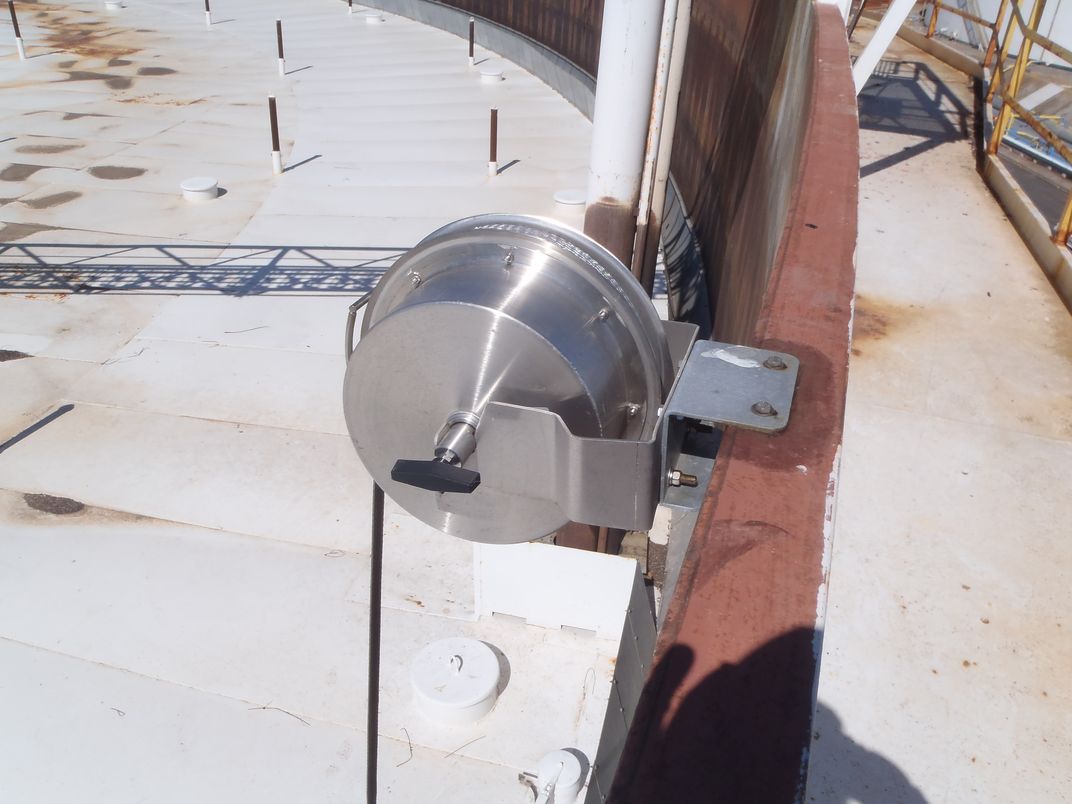
Reliable Performance in Harsh Environments
Beyond superior safety, bypass conductors deliver clear operational advantages:- Longevity: Up to 30 years of service life under normal conditions.
- Practicality: Installation is straightforward and can be performed without tank evacuation.
- Support: Replacement cables and inspection services ensure long-term reliability without major downtime.
The Business Case: Cost vs. Catastrophe
Lightning-related tank fires can cause tens or hundreds of millions in damages from lost product and equipment replacement to environmental cleanup, community impact, as well as potential regulatory actions. In contrast, installing a bypass conductor costs roughly $25,000 per tank.The value proposition for investing in a bypass conductor solution is clear: a modest investment to eliminate the most common ignition source on EFRTs. Yet adoption has often lagged due to corporate culture and budgeting hurdles. It is difficult to quantify the probability of a lightning strike occurrence, but in most cases it is a question of when, not if one will occur. Consequently, many companies only act during scheduled overhauls, or when required by regulation. But forward-thinking operators recognize that proactive investment in bypass conductors is cheaper, safer, and smarter than gambling on luck.
What API 545 Still Teaches Us
The withdrawal of API 545 doesn’t diminish its value. Instead, it underscores a key truth: safety standards must be practical as well as scientifically sound.Bypass conductors remain the most effective, cost-efficient, and field-proven solution to reduce lightning-related fires in floating roof tanks. Installing them isn’t just about compliance - it’s about protecting people, assets, and communities from preventable disasters.
Ready to strengthen your lightning protection strategy? Contact Lightning Eliminators today to learn how our Retractable Grounding Assembly (RGA) and comprehensive lightning mitigation systems can help keep you running through the storm.
Spread the love