- We Prevent Lightning Related Problems.


NFPA 780 Lightning Protection System: Advantages of Spline Ball Terminals
July 8, 2025
Lightning Protection for Power Plants | Case Studies
August 13, 2025Lightning Protection for Hydrogen Powered Operations

How the Rise of Fuel Cell Usage is Putting New Types of Facilities at Risk
Forklifts power the movement of goods in warehouses and fulfillment centers, making them essential to daily operations. Traditionally, forklifts have run on lead-acid batteries. They’re dependable, affordable, and well understood – but they’re also heavy, slow to charge, and prone to maintenance headaches. Additionally, lead is toxic, and improper disposal or recycling can be hazardous. Disposing old lead-acid batteries increases environmental compliance burden and potential for contamination.
As operational demands increase and sustainability goals become more pressing, many industrial facilities are turning to cleaner, faster technologies like hydrogen fuel cells.
Why Hydrogen Power?
Hydrogen fuel cells offer major advantages over lead-acid batteries: faster refueling times, higher energy density, and fewer emissions. For fulfillment centers, this translates into less downtime, better throughput, and a lighter carbon footprint.
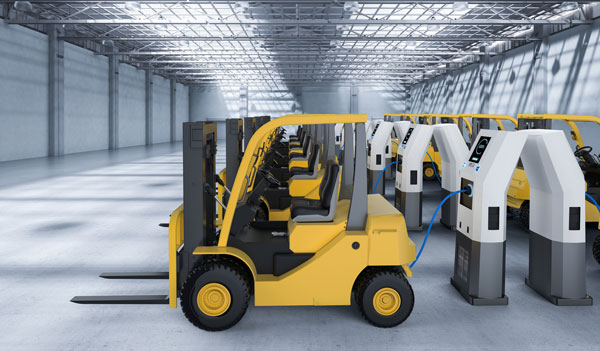
But adopting hydrogen also comes with a new set of infrastructure and safety requirements. Facilities must either receive hydrogen via tube trailers or generate it onsite, often using electrolyzers. Either option significantly increases the presence of flammable gases, high-pressure systems, and potential ignition sources – raising the stakes for lightning protection.
The Hidden Risk of Hydrogen: Lightning Strikes
Hydrogen is highly combustible, as historical events like the Hindenburg tragedy graphically demonstrate. With hydrogen in play, a single lightning strike could turn costly or catastrophic. Traditional lightning protection systems (LPS), such as Franklin rods, aren’t always enough to mitigate this risk. In fact, they may inadvertently invite lightning into the area they’re meant to protect by serving as attractive strike targets. For hydrogen-powered operations, that’s a risk no facility can afford.
Why Traditional Lightning Protection Falls Short
Conventional lightning protection systems work by safely attracting and conducting a lightning strike into the ground. While this approach can protect structures from fire or damage, it does little to prevent the strike in the first place. In some cases, these systems can create high field intensities that increase the likelihood of an upward streamer forming – effectively encouraging a strike.
This is especially dangerous in areas where flammable gases like hydrogen are present. Redirecting lightning may not be enough – you need to prevent it from coming near high-risk areas altogether.
READ MORE: Lightning Protection & Safety Frequently Asked Questions
A Better Approach: Dissipation Array® Systems (DAS®) for Lightning Prevention
Lightning Eliminators & Consultants (LEC) offers a smarter alternative: Dissipation Array Systems. Unlike traditional lightning rods, DAS technology works to prevent lightning strikes from forming in protected areas by neutralizing the electrical field buildup that precedes a strike. What does that mean for you? No high-voltage field means no streamer formation – and without a streamer, lightning can’t strike.
This proactive approach is backed by decades of engineering, real-world performance, and third-party validation.
Highlights from Independent Testing
1. Westinghouse Savannah River Company Process Canyons, Aiken, South Carolina, USA (1991)
In 1991, multiple DAS units were installed to protect buildings at the Savannah River nuclear processing site. A report to evaluate the DAS concluded that the DAS protected area “did not experienced any losses from a direct lightning flash to the protected area.”
2. Hitachi Testing #1, Tokyo, Japan (1997)
In 1997, engineers of the Hitachi Techno Engineering Company simulated the ionizing effect of a DAS by placing a modular ionizer and a conventional air terminal in a high voltage field, in a comparative test. Video of the test showed arcing to the conventional air terminal but not the modular ionizer during identical conditions. The test report concluded that “the electrical field would be decreased by multi points Ionizer (DAS) drastically.”
3. Tennessee Valley Authority, Browns Ferry Nuclear Power Plant, Athens, Alabama, USA (1998)
In 1998, a DAS was installed on a stack with a history of lightning strikes. After DAS installation, they have experienced zero strikes to the stack, as well as an 80% reduction of lightning strikes near the stack.
4. Ministry of Defense, Singapore (1999)
In 1999, military engineers tested the effectiveness of the DAS at Sembawang Air Base. The report states that “the DAS has shown positively that it is capable of preventing lightning strikes to the region it protects.”
5. Tri State Generation & Transmission, Westminster, Colorado, USA (2007)
In the summer of 2007, a test was conducted to measure electric field strengths at a DAS site. Field strengths were measured both within and outside of the DAS protected area. It was found that the DAS caused an average field strength reduction of 55%. The lower the field strength, the less likely it is to develop an upward streamer. No strikes have been reported at this site since its original installation in 1991.
6. NTS Lightning Technologies Testing, Pittsfield, Massachusetts (2017)
In May 2017, NTS Lightning Technologies in Pittsfield, Massachusetts, conducted a series of high voltage tests to compare the ionization rates of different types of air terminals. Four different terminals were tested: an LEC Dissipation Array Hemisphere, an LEC Spline Ball Terminal, a Lightning Master terminal and a conventional air terminal. The test results show that the discharge current from the DAS Hemisphere is substantially greater than that for the other types of terminals, on the order of 15 times that of a conventional air terminal. The greater the discharge current, the less likely it is to form upward streamers.
Protect Your Hydrogen Investment
From eliminating strikes at nuclear facilities like Savannah River and Browns Ferry to successful military validation in Singapore, DAS has consistently delivered. As fulfillment centers modernize with hydrogen fuel cells, it’s essential to rethink how you protect people, property, and operations from lightning. Don’t settle for outdated systems that only react – choose a solution designed to prevent.