- We Prevent Lightning Related Problems.


Lightning Protection for Power Plants | Case Studies
August 13, 20253 Effects of Lightning Damage
August 29, 2025The Largest Oil Storage Facilities in the World: Why Lightning Protection for Floating Roof Tanks Matters
at
Oil storage facilities perform a critical a function in the global energy supply chain. Massive tank farms and terminals – spanning hundreds of acres – store, blend, and distribute millions of barrels of crude oil and refined products every year. But with their sheer scale and flammable inventories, these facilities face a constant, potentially catastrophic risk: lightning strikes.
In this article, we cover some of the world’s largest oil tank farms and terminals, and why advanced lightning protection systems - including LEC’s Dissipation Array System (DAS) and Retractable Grounding Assembly (RGA) for floating roof tanks - are critical for safety, operational continuity, and risk mitigation.
In this article, we cover some of the world’s largest oil tank farms and terminals, and why advanced lightning protection systems - including LEC’s Dissipation Array System (DAS) and Retractable Grounding Assembly (RGA) for floating roof tanks - are critical for safety, operational continuity, and risk mitigation.
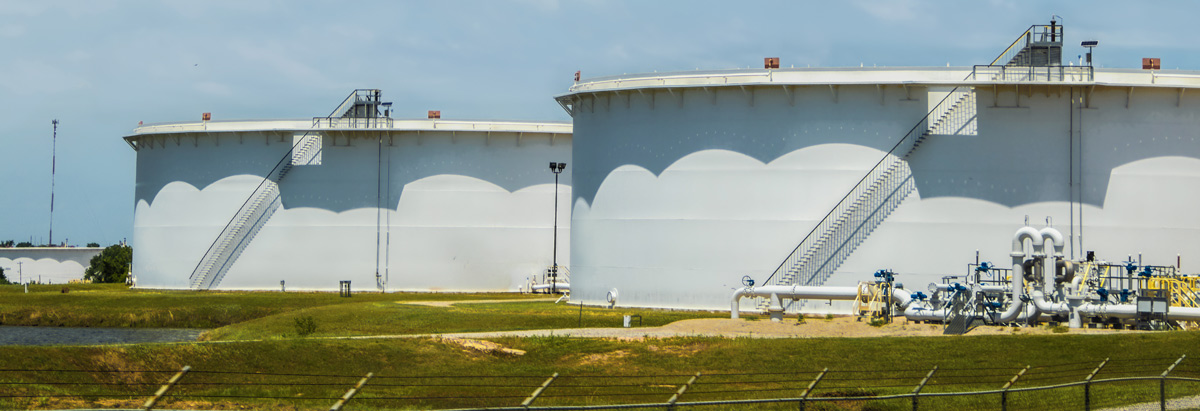
Global Giants: The Largest Oil Storage Facilities in the World
1. Cushing, Oklahoma, USA.- Known as the "Pipeline Crossroads of the World," Cushing is the delivery point for West Texas Intermediate (WTI) crude oil futures.
- Capacity: Approximately 90–91 million barrels of crude oil.
- Significance: A major hub for U.S. pipeline infrastructure and crude oil storage.
2. Buckeye Bahamas Hub, Freeport, The Bahamas
- Capacity: Approximately 26 million barrels across 80 storage tanks.
- Significance: A key marine terminal connecting global crude and refined product markets.
3. Maasvlakte Olie Terminal (MOT), Rotterdam, Netherlands
- • Capacity: Approximately 6.8 million barrels across 39 tanks.
- • Significance: Europe’s largest crude oil terminal, serving the Rotterdam-Antwerp-Amsterdam (ARA) refinery cluster.
4. Fujairah Oil Terminal, UAE
- Capacity: Approximately 7.4 million barrels (including underground storage caverns).
- Significance: One of the world’s top trading hubs, strategically located outside the Strait of Hormuz.
5. Sangachal Terminal, Azerbaijan
- Capacity: Approximately 3 million barrels.
- Significance: Major export hub for Caspian crude oil. Operated by BP, the Sangachal terminal is a vital link in Azerbaijan’s oil and gas industry that receives, processes, stores and exports crude oil and gas produced from all currently operated BP assets in the Caspian basin.
6. Valdez Marine Terminal, Alaska, USA
- Capacity: Approximately 6.6 million barrels in 14 storage tanks.
- Significance: Terminus of the Trans-Alaska Pipeline System (TAPS).
LEC’s RGA has over 18,000 installations globally, including at many of these facilities.
The Lightning Risk for Floating Roof Tanks
Floating roof tanks (FRTs) are widely used in crude oil storage due to their ability to minimize vapor space and reduce emissions. However, they are particularly vulnerable to lightning:- Seal area fires. Lightning-induced voltage differences between the roof and shell can cause arcing at the tank’s rim seals - one of the most common causes of tank fires.
- Direct strikes. The exposed floating roof acts like a large metal target, attracting lightning.
- Static charge buildup. Weather conditions such as wind or precipitation can exacerbate static charges, which may discharge explosively during a lightning event or at any other time
According to industry studies and NFPA 780, lightning accounts for over 30% of floating roof tank fires globally. A single incident can result in millions of dollars in product loss, costly downtime, and severe environmental impacts.
How LEC Protects Mega-Terminals
Dissipation Array System® (DAS®)
Lightning Eliminators & Consultants (LEC) developed the Dissipation Array System®, a patented lightning prevention technology that reduces the risk of direct strikes by neutralizing the electrical field above a facility. Unlike traditional lightning rods, which attract lightning, a properly maintained DAS system completely prevents strikes from occurring within the protected area.We are so confident in the performance of the Dissipation Array System (DAS) that we offer a full no-strike warranty to every client who purchases a system and maintains annual recertification. Backed by more than 60,000 system-years of data across nearly 3,500 installations, the DAS has demonstrated a proven reliability rate of 99.87%. For massive oil terminals like Cushing, Rotterdam, or Fujairah, DAS provides:
- Proactive prevention of tank fires by reducing direct lightning strike risks.
- Enhanced safety and operational uptime during storm activity.
- Field-proven reliability, with successful installations since 1971 across tank farms, refineries, and critical energy infrastructure.
Retractable Grounding Assembly® (RGA®) GEN 2
Targeted Floating Roof Tank Protection While DAS addresses the broader facility-wide risk, floating roof tanks require localized lightning bonding solutions. LEC’s Retractable Grounding Assembly (RGA) is the industry’s most advanced bypass conductor system for FRTs.- Engineered for durability and reliability, the RGA ensures a permanent, low-impedance bond that prevents fires triggered by lightning currents.
- It ensures that lightning currents are safely diverted away from the rim seals, eliminating arcing and sparking hazards.
- The retractable design prevents mechanical wear and ensures continuous, reliable contact regardless of roof movement or product level.
- More than 18,000 RGAs are in service today protecting FRTs.
- NFPA 780 and API 545-compliant solution for floating roof tank lightning protection.
- Reduces maintenance costs compared to older wire-shunt systems.
- Proven performance at global mega-terminals, including facilities with hundreds of tanks.
The Cost of Ignoring Lightning Protection
For the world’s largest oil terminals, the consequences of lightning related effects are high:- Financial Losses. A single lightning-induced tank fire can cost tens of millions in product loss, facility damage, and cleanup.
- Downtime. Damage to even one tank can disrupt entire supply chains, particularly at export hubs like Rotterdam or Cushing.
- Safety Risks. Lightning incidents put workers and nearby communities at risk.
- Environmental Impact. Fires and spills caused by tank damage lead to long-term ecological damage and regulatory penalties.
- Corporate Reputational Risk. Fires, injuries, and negative impacts to local communities can impair your corporate reputation, leading to greater scrutiny, regulation, and enforcement actions.
Investing in advanced preventive systems like DAS and RGA is typically far more cost-effective than responding to a single major incident.
Conclusion
The world’s largest oil tank farms, whether in Cushing Oklahoma, Rotterdam, or elsewhere, are engineering marvels that underpin global energy logistics. But with their scale and exposure, lightning continues to be a clear and present danger.Our DAS and RGA solutions work together to provide a comprehensive lightning protection strategy to Keep You Running Through the Storm:
- DAS prevents direct lightning strikes across the entire facility.
- RGA protects floating roof tanks from internal arcing hazards.
By adopting advanced lightning protection technologies, operators can safeguard lives, reduce operational risks, and protect billions of dollars in assets.
Contact us today to learn more about our lightning protection solutions for floating roof and fixed roof tanks.
Spread the love


