- We Prevent Lightning Related Problems.


Lightning Eliminators’ Joe Lanzoni Shares Small Business Export Insights at US-Peru Trade Panel
December 9, 2025
Proven Expertise to Keep You Running Through the Storm
February 2, 2026How To Prevent Lightning: The Science Behind Stopping Strikes Before They Happen
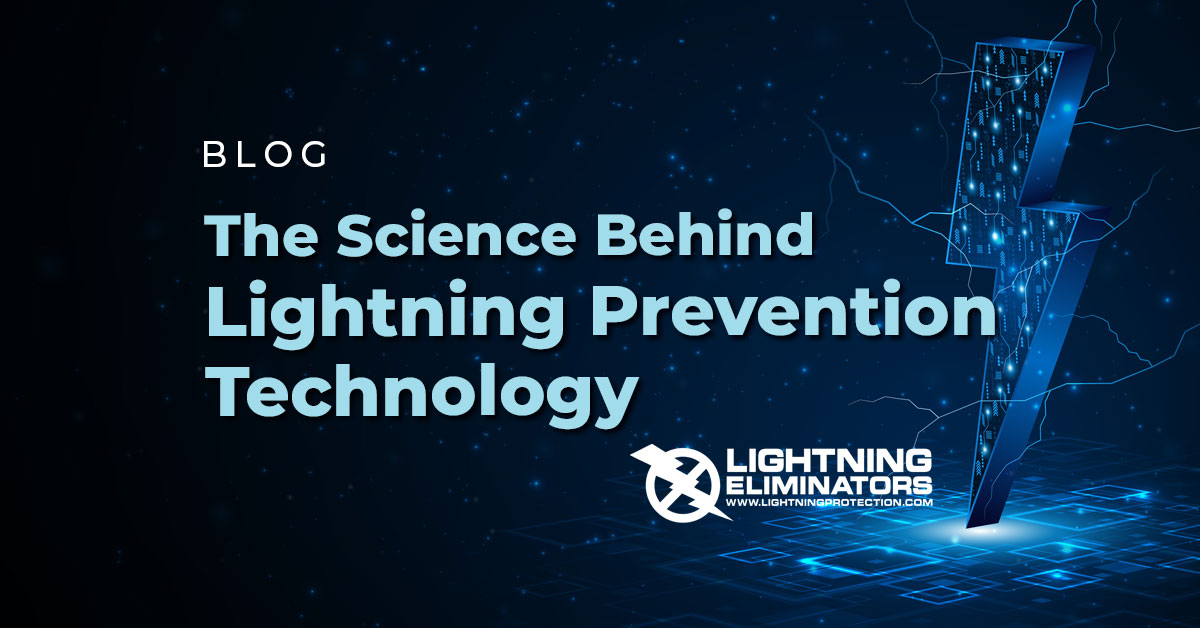
When most people think about lightning protection, they imagine tall rods and metal conductors ready attract and collect a strike and safely guide it to the ground. Although this is preferable to a direct strike, this traditional method unfortunately works by attracting lightning into the area we want to protect! Which begs the question – what if there was a way to stop lightning from forming in the first place?
That’s the idea behind lightning prevention. Instead of redirecting a strike after it begins, lightning prevention systems stabilize the electrical field around a finite protected area, retarding or delaying the formation of upward streamers. Through controlled charge transfer, lightning prevention units retard the formation of upward streamers, making the protected area less conducive to lightning initiation.
The Physics: How Lightning Forms
To understand how prevention works, it helps to know how lightning forms. The type most concerning for people and infrastructure is cloud-to-ground lightning.
As a storm cell builds, electrical charges separate within the cloud: negative charges concentrate near its base, while positive charges accumulate in the upper regions. In response, the ground beneath the cloud becomes positively charged, creating a powerful static field between the base of the cloud and ground, including structures, trees, and other ground-level features.
When this field grows strong enough, a stepped leader – an invisible, branching channel of negative charge – moves downward from the cloud in a series of rapid jumps. As it nears the ground, tall structures or isolated objects may launch their own upward streamers of positive charge.
As they say, opposites attract, and if one of those positively charged upward streamers connects with a negatively charged descending leader, the lightning circuit is completed. In a split second, a massive surge of current – documented in the range of 4,000 to 250,000 amperes – flows between cloud and earth. That’s the flash we see, and the resulting heat can ignite fires and explosions, resulting in equipment damage and costly downtime.
Read More: Charge Transfer Technology
Lightning Prevention Technology in Action
Lightning prevention systems, such as charge-transfer or multi point ionization terminals, take a fundamentally different approach than traditional lightning rods. Instead of waiting for a stepped leader to descend from a nearby cloud, they continuously manage the electrical environment around a protected site.
Charge Transfer Systems™ (CTS™), such as Lightning Eliminators’ Dissipation Array® System (DAS®), work by collecting the induced charge that thunderstorm clouds create over a protected area and then transfers it into the surrounding air through a specialized ionizer. The science behind this process, known as point discharge, occurs when a sharp point immersed in an electrostatic field gradually and continuously releases small amounts of charge (electrons) into the atmosphere.

These released ions create an environment that prevents the conditions that lead to upward streamer formation. By continuously bleeding off excess charge and reducing the potential disequilibrium of charge between the cloud and ground, the system prevents the conditions that lead to upward streamer formation.
In simple terms: Charge Transfer Systems create an environment in the finite protected area where the electric field gradient drops, making it far less likely that your positively charged electrons will “reach up” toward an approaching leader from a negatively charged cloud base. Because the system is always active, protection isn’t limited to a split-second event – it’s a constant stabilizing presence throughout every thunderstorm.
Benefits and Use Cases for Lightning Pevention
Lightning prevention technology (charge transfer) is more than theoretical – it’s a proven, field-tested protection method that answers the question, how to prevent lightning strikes.
- Protects critical infrastructure. Lightning prevention systems protect mission-critical infrastructure – ranging from refineries and oil & gas facilities, to power plants, data centers, water treatment plants, communications towers, petroleum storage tanks, and renewable-energy farms – where unplanned outages are simply not an option.
- Keeps operations running. By reducing the likelihood of direct strikes, businesses experience fewer shutdowns and less downtime during severe weather, avoiding significant losses and preserving customer relationships.
- Lowers risk and cost. Preventing strikes minimizes fire hazards, equipment failure, and maintenance expenses – helping organizations save on repairs and insurance claims.
- Proactive protection. Traditional lightning rods and grounding systems are reactive: they handle lightning after it forms. Prevention is proactive, preventing the conditions that allow lightning to form in the first place.
This proactive model is particularly valuable for industries where continuity and safety are paramount. For instance, oil and gas facilities rely on prevention to avoid ignition hazards; utilities deploy it to maintain uptime across large grids; and telecom operators use it to keep network towers online through the storm season.
Common FAQs and Misconceptions
“Isn’t grounding enough?”
Grounding systems are helpful, but they’re reactive – they attempt to manage lightning after it has already hit, bringing lightning close to protected structures and potentially creating proximal surges. Prevention systems, by contrast, address the root cause: they reduce electric field buildup to prevent the strike entirely. Used together, grounding and prevention can create a holistic defense.
“Metal makes structures more likely to be struck.”
Not true. Lightning chooses its path based on height, shape, and isolation – not material composition. Metal is an excellent conductor for safely channeling energy once a strike occurs, but it doesn’t necessarily attract lightning.
“Do prevention systems require heavy maintenance?”
Charge transfer systems are largely passive once installed. Regular inspections ensure terminals are clean and connections are intact, but there are no moving parts or consumables. With proper installation and periodic maintenance, these systems can provide reliable service for decades.
Science-Backed Lighting Prevention for the Real World
Lightning remains one of nature’s most unpredictable and destructive forces, but it’s not uncontrollable. With charge transfer technology, it’s possible to prevent lightning strikes before they happen, turning potential flashpoints into harmless atmospheric balance.
At Lightning Eliminators & Consultants, we’ve pioneered the development of lightning prevention solutions for more than 50 years across multiple industries in more than 80 countries worldwide. From petrochemical facilities to data centers and renewable energy installations, our systems have protected critical infrastructure through tens of thousands of storms.