- We Prevent Lightning Related Problems.


Grounding and Bonding Floating Roof Storage Tanks
May 19, 2026
Celebrating 23 Years of Dedication: Gary Williams Announces Retirement
July 30, 2026Lightning Strike Prevention: Dissipation Array® System Configurations for Oil Storage Sites
Why Lightning Prevention Beats Protection in Petroleum Storage
Traditional lightning protection systems – lightning rods, air terminals, and surge arrestors – accept the premise that lightning will strike and attempt to control where it strikes and how the resulting energy is routed. This is a reasonable approach for structures where the consequences of a controlled strike are manageable. For crude oil storage tanks, it is fundamentally insufficient.
The problem is that even a controlled strike on a petroleum storage tank is still a strike on a petroleum storage tank. Even when the energy is routed safely to ground, the arc at the point of contact can ignite vapor at a tank seal, a vent, or a fitting. Floating roof tanks are particularly vulnerable at the rim seal – the annular gap between the floating roof and the tank shell, where accumulated vapors are closest to the surface. A strike that is “successfully” conducted to ground may still produce ignition-capable energy at the most dangerous point on the tank.
Dissipation Array® System (DAS®) units eliminate this dilemma. By preventing the strike from occurring within the protected area, it eliminates the source of ignition in the protected area rather than simply managing the energy after ignition is already possible.
The Science Behind DAS Lightning Strike Prevention Systems
Lightning is nature’s mechanism for equalizing the voltage differential between storm clouds and the earth. When that charge differential reaches a critical threshold, the cloud begins extending downward leaders – invisible channels of ionized air reaching toward the ground. Simultaneously, objects on the ground, including storage tanks, stacks, and structural steel, begin forming upward streamers – rising channels of ionized air reaching toward the cloud. When a downward leader connects with an upward streamer, the circuit is complete and a lightning bolt follows that path.
DAS systems interrupt this process at the streamer formation stage, using a phenomenon called point discharge. When a well-grounded conductive point is placed in a strong electric field, it continuously exchanges ions between the surrounding air and the ground. By deploying an array of many such points – the ionizing elements that give the DAS its distinctive appearance – the system gently bleeds the local charge differential, reducing the electric field strength in the protected area to below the threshold required for streamer formation. No streamers form; no connection with the cloud’s downward leaders can be made; no strike occurs.
We call this approach as charge transfer technology – a continuous, passive process that requires no external power source, triggers no loud mechanical action, and produces no byproducts. The DAS simply changes the local electrical environment so that the conditions for a strike cannot manifest.
Dissipation Array System Configurations for Oil Storage Applications
One of the most important attributes of DAS lightning prevention system is its adaptability. The ionizing array must be configured to match the geometry of the structure being protected, because the shape and position of the array determines the shape and extent of the protected volume. LEC has developed a range of standard configurations, several of which are specifically suited to the varied structures found at oil terminals, refineries, and well sites.
Conic Array — Fixed Roof Tanks
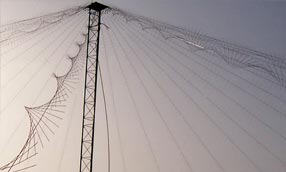
The conic array is designed for cone and dome roof storage tanks, widely used in petrochemical and flammable storage applications. Fixed roof tanks – used where vapor pressures are lower or a floating roof isn’t practical – present a challenging geometry: the roof slopes away from a central apex. The conic array wraps around this profile, distributing ionizing elements along the cone’s surface to protect the entire roof and ullage space beneath. For crude oil tank batteries at well sites and fixed roof receiving tanks at terminals, it is typically the primary DAS configuration.
Rim Array — Floating Roof Tanks
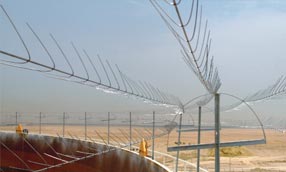
Floating roof tanks are among the highest-risk assets at any oil terminal or tank farm. The floating roof rises and falls with liquid level, and the rim seal – the dynamic interface between the roof edge and the tank shell – is the most common point of lightning-induced ignition. The rim array mounts directly to the floating roof, moving with it as product levels change to maintain continuous protection at this most vulnerable location. It is often deployed alongside LEC’s Retractable Grounding Assembly, which ensures a consistent, low-impedance bond between the floating roof and tank shell regardless of roof position.
Stack Array — Flare Stacks and Process Stacks
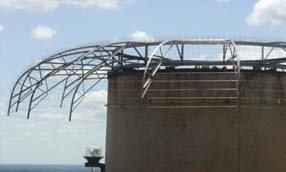
Refineries and processing facilities typically include flare stacks, relief stacks, and process exhaust stacks that extend well above surrounding structures and create natural lightning attraction points. The stack array is designed for industrial smoke and exhaust stacks, with corrosion-resistant configurations available to address the chemically aggressive environments common around petrochemical processing. A DAS stack array converts a lightning-attractive structure into a lightning-prevention asset, using the stack’s height to maximize the effective radius of charge transfer.
Hemisphere Array — Vertical Structures, Poles, and Towers
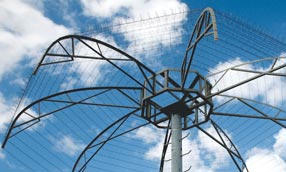
The hemisphere array is LEC’s most versatile configuration, suitable for placement on any industrial or commercial structure including poles, buildings, and towers. In oil and gas facilities, it is commonly used on instrument poles, communication towers, elevated flare ignition systems, wellhead structures, and other vertical assets. Its hemispherical form produces a broadly conical protected volume below and around the mounting point, making it effective for isolated structures where a simpler, more compact installation is appropriate
Parapet Array — Flat Roof Process Buildings
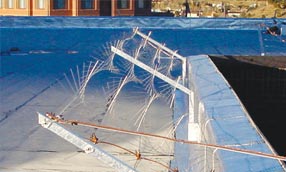
Process buildings at refineries and terminals – control rooms, pump houses, electrical switch gear buildings, and compressor stations – are frequently constructed with flat roofs and parapet walls around the perimeter. The parapet array is designed for this specific architecture, mounting along the parapet edge to create a continuous protective barrier. Because the electronics and control systems inside these buildings are critical to facility-wide operations, lightning protection for process buildings is an important element of any comprehensive tank farm protection strategy.
Flat Roof Array — Supplemental Roof Coverage
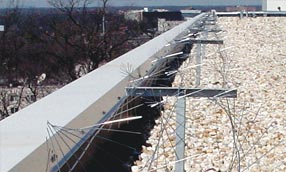
For flat-roof buildings where additional interior coverage is needed beyond what the parapet array provides – particularly on large-footprint buildings – the flat roof array can be deployed on the roof surface itself. It may also be used as the primary configuration on flat-roof structures that lack a parapet. In facilities where process buildings are large enough that the parapet-mounted array alone cannot cover the entire roof area, a combination of parapet and flat roof arrays provide complete overhead protection.
Paragon Array — Multi-Use and Transmission Line Protection
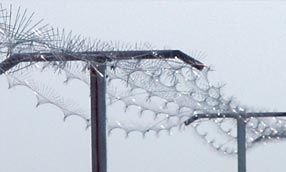
The paragon array is a multi-use configuration with a variant commonly deployed on transmission and distribution power lines. In the context of oil terminals and refineries, it is applicable to elevated structures that serve multiple protection functions or that have irregular geometries not well suited to other configurations. It is also relevant for protecting the incoming power infrastructure that supplies electricity to pumping stations, control systems, and processing equipment – a lightning strike on a power line can cause the same surge damage to facility electronics as a direct strike to the facility itself.
Trapezoid Array — Guy-Wire Supported Structures
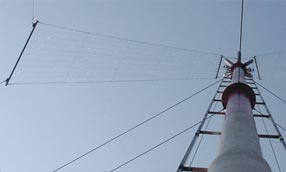
Some installations use guy wire supported structures – antenna towers for remote SCADA communication, flare stacks at remote well sites, or elevated lighting masts – where the geometry of the structure includes the characteristic angle of the supporting cables. The trapezoid array is engineered for industrial and commercial structures with guy ropes, and importantly, it is effective even if the protected structure is not the highest point in the area. This is particularly valuable at well sites where a DAS-protected structure might be surrounded by taller trees or terrain features.
DAS Applications Across the Oil and Gas Value Chain
Oil Terminals and Tank Farms
Large crude oil terminals and product tank farms are ideal candidates for a comprehensive DAS deployment that combines multiple array configurations. A typical terminal might include dozens of floating roof crude oil tanks (rim arrays), fixed roof product storage tanks (conic arrays), process buildings (parapet and flat roof arrays), flare stacks (stack arrays), communication towers (hemisphere or trapezoid arrays), and incoming power infrastructure (paragon arrays for line protection).
Our engineering team starts with a detailed site survey and risk map before specifying the system, identifying strike probability zones, vulnerable equipment, and the potential financial and operational cost of a major lightning-induced incident. Major operators including BP, ExxonMobil, Chevron, ADNOC/TAKREER, Petrobras, and PEMEX have trusted LEC systems at terminals around the world.
Refineries
Refineries present an exceptionally complex lightning protection challenge. The combination of tall structures (fractionating columns, heaters, flare stacks), vast areas of pipe rack and heat exchanger infrastructure, sensitive instrumentation and control systems, and the ubiquitous presence of flammable hydrocarbons creates numerous potential ignition scenarios.
A refinery DAS deployment will typically combine stack arrays on process towers and flare systems, parapet and flat roof arrays on control buildings and switch gear rooms, hemisphere arrays on isolated instrument poles and sample points, and conic arrays on any fixed roof product storage. The DAS’s integration with TVSS surge protection is especially important in refineries, where SCADA and distributed control system (DCS) equipment represents enormous capital investment and where unplanned downtime carries enormous financial cost.
Well Sites and Tank Batteries
At the upstream end of the value chain, well sites, including wells, production equipment, and tank battery systems used to collect, separate, and store produced crude oil and water before takeaway via pipeline or truck face a different set of challenges. Well sites are often in remote locations with no nearby tall structures to divert lightning away from the tanks, the wellhead, or the associated electrical equipment.
Tank batteries typically consist of a series of fixed roof tanks arranged in a cluster, along with separators, heaters, and metering equipment. The conic array is the natural choice for individual cone roof stock tanks, while hemisphere arrays on poles or masts can extend protection over an entire tank battery. The combination of DAS prevention with proper grounding through Chem-Rod electrodes is particularly important at remote sites where the cost and logistical challenge of responding to a fire or equipment failure is substantially higher than in a terminal setting.
No-Strike Warranty
LEC’s warranty on supervised installations provides a level of contractual assurance that is unavailable from any conventional lightning rod or air terminal system – a meaningful differentiator when evaluating protection options for high-value petroleum assets.
Conclusion
Lightning is a constant threat to crude oil storage and processing infrastructure, and the consequences of a lightning-induced fire or explosion at a tank farm, refinery, or well site extend far beyond the immediate physical damage. The Dissipation Array System represents a fundamentally superior approach to this threat – not by making lightning safer to capture and redirect, but by changing the local electrical environment so that lightning does not strike within the protected area at all.
With configurations tailored to every structure type found in petroleum storage and processing, DAS technology can be engineered to protect every element of a tank terminal, refinery, or well site within a single integrated system.
For operators responsible for protecting their people, their assets, and their operations from one of nature’s most unpredictable hazards, the DAS solution offers something no conventional lightning rod can match: the opportunity to keep running through the storm.
For more information on the Dissipation Array System and LEC’s full range of lightning protection systems for the oil and gas industry, visit lightningprotection.com.